
Selling products overseas is not just a “big brand only” move because it’s quickly becoming the default growth strategy. With nearly 58% of global shoppers buying from international sellers, demand for overseas products is rising fast. So if customers are shopping globally, why should your brand stay limited to one country?
And if you’re planning to expand internationally but wondering how customs clearance works, here’s some good news. A Courier Bill of Entry (CBE) helps shipments clear customs quickly and in compliance when goods are imported via courier. From SMEs to large brands, businesses rely on it to keep cross-border shipments smooth, fast, and hassle-free.
This blog breaks down everything you need to know about the Courier Bill of Entry, including its importance, purpose, types, steps in the process, and required documents.
Courier Bill of Entry Meaning Explained for Brands Going Global
Ever ordered something from overseas and wondered how it clears customs so quickly? That smooth entry is often thanks to a CBE.
A Courier Bill of Entry (CBE) is a document that allows goods to legally enter a country through customs when they arrive via courier shipments.
A courier bill of Entry Format typically contains:
- Importer information (name, address, IEC)
- Shipment details (description, quantity, value)
- Courier details and tracking information
- Applicable duty or taxes
- HS code for classification
Its main purpose is simple help customs process shipments faster while ensuring compliance with all import rules and regulations.
It is typically required when:
- Goods are imported via express courier services (e.g., DHL, FedEx, UPS).
- Shipments are handled under courier regulations rather than traditional cargo clearance.
- The consignment value falls within the prescribed thresholds and meets the eligibility criteria for courier clearance.
Know the Types of Courier Bill of Entry Before You Import
Now that you understand what a Courier Bill of Entry is and when it’s typically required, the next step is to determine which type applies to your shipment. Because the type depends on what you’re importing and its value, choosing the right one keeps clearance smooth and delay-free.
So, let’s break down each type and where it fits.
1. Bill of Entry – Form XI (CBE-XI)
- Used when a courier shipment contains documents only with no commercial value, such as letters, contracts, reports, or printed materials.
- No customs duty applies, and clearance is usually quick.
- Ideal for businesses receiving official documents from overseas.
2. Bill of Entry – Form XII (CBE-XII)
- Used for gifts and samples imported through courier for personal use and not meant for resale.
- The assessable value is typically up to ₹10,000, and duty may apply depending on the item category.
- Common for trial samples, promotional items, or small personal gifts.
3. Bill of Entry – Form XIII (CBE-XIII)
- Used for dutiable goods imported through courier for personal use, with an assessable value of up to ₹1,00,000.
- This applies to items not intended for resale that still attract customs duty based on their category.
- Common for low-value electronics, clothing, footwear, and personal accessories ordered from overseas.
4. Bill of Entry – Form XIV (CBE-XIV)
- Used for high-value or commercial shipments imported through a courier.
- This applies when the shipment value exceeds ₹1,00,000 or when the goods do not fall under any of the earlier categories.
- It is commonly filed for commercial consignments and follows standard customs assessment procedures.
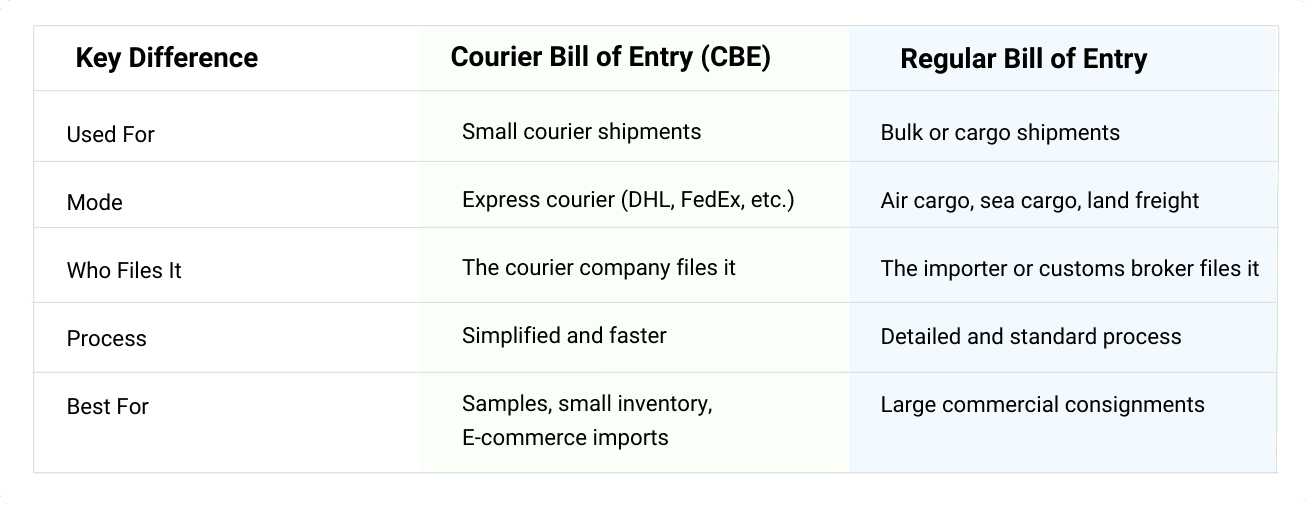
How Does The Courier Bill of Entry Differ From The Regular Process?
So, now you might be wondering, how is this different from the regular import clearance process? While both are used to clear goods through customs, the steps, paperwork, and timelines can vary based on how the shipment arrives.
To make it easier to understand, let’s look at a quick comparison.
Step-by-Step Guide to Filing a Courier Bill of Entry?
Now, when you understand the types, differences, and you are going ahead with filing a courier bill of entry.. Then let’s see the Indian custom EDI system that makes the courier bill of entry document submission easier. Here’s a step-by-step guide:
1. Gather All Required Documents
Before anything else, collect all the essential papers, including:
- Commercial invoice
- Packing list
- KYC documents (Importer)
- Importer Exporter Code (IEC)
- Certificate of Origin
- Authorization letter (if required)
Having these ready upfront makes the filing process smooth and avoids last-minute hiccups.
2. Register and File on ICEGATE
Log in to the ICEGATE portal and choose the type of Bill of Entry based on your import:
- Home Consumption BoE
- Warehousing BoE
- Ex-Bond BoE
Enter all important details like importer info and shipment details, attach scanned copies of required documents, and submit. Once verified, you can pay any duties online via ICEGATE using internet banking or NEFT/RTGS.
3. Clearance & Shipment Tracking
After submission and duty payment, customs may inspect your shipment. Once cleared, you’ll receive the Out-of-Charge (OOC) order, which officially releases your goods.
You can then track your shipment through ICEGATE or the courier bill of entry tracking system until it reaches your doorstep.
Key Benefits of Using Courier Bills for Entry for Fast Customs Clearance
India is steadily moving towards paperless customs processes, cutting dwell times and giving a big boost to eCommerce sellers. Recent overseas rules and digital initiatives have made cross-border imports much simpler, and the Courier Bill of Entry (CBE) is a key part of this shift.
With digital filing and pre-arrival processing systems reducing average overseas clearance time by up to 60%, CBEs make importing faster, smoother, and hassle-free.
But that’s not all, CBEs benefit importers in several other ways too. Let’s take a look:
1. Quick Clearance
CBEs are designed for small parcels, samples, and documents, so customs processing is much faster compared to the regular cargo route.
2. Less Paperwork
Unlike traditional bills of entry, the courier mode requires minimal documentation. Most of the filing is handled electronically by the courier company, saving you time and effort.
3. Lower Costs for Small Shipments
For low-value goods, CBEs reduce unnecessary administrative costs and simplify duty calculation, especially for shipments under prescribed thresholds.
4. Better Tracking & Transparency
You can track your shipment status online via ICEGATE or the courier’s tracking system, so you always know where your goods are in the clearance process.
5. Smooth Compliance
CBEs ensure that all required regulations, duties, and documentation are properly handled, reducing the chances of delays or customs issues.
6. Ideal for E-commerce & SMEs
Small businesses importing samples, promotional items, or inventory in limited quantities benefit the most, as CBEs make cross-border trade easier and more predictable.
Wrapping Up
Selling products overseas has never been simpler. The Courier Bill of Entry (CBE) streamlines customs clearance, cuts down on paperwork, and saves time for both SMEs and big brands. With digital filing, pre-arrival processing, and easy tracking, you stay in control of your shipments and can focus on growing your business instead of getting stuck in documentation.
Whether it’s trial products, promotional items, or inventory for resale, knowing the right type of CBE and filing it correctly ensures fast, hassle-free cross-border shipping. Think of it as your fast-pass through customs, helping your products reach customers quickly, smoothly, and without unnecessary delays.
What is the bill of entry for a courier?
A Courier Bill of Entry (CBE) is a document that allows goods to legally enter a country via courier shipments. It includes shipment details, importer information, HS code, and applicable duties to ensure fast and compliant customs clearance.
How to find the courier bill of entry?
You can track or find your courier bill of entry on the ICEGATE portal or through your courier’s tracking system using your CBE number and filing date.
What is the type of courier Bill of Entry?
There are four main types:
- CBE-XI – Non-commercial documents
- CBE-XII – Gifts and samples under ₹10,000
- CBE-XIII – Dutiable personal imports up to ₹1,00,000
- CBE-XIV – High-value or commercial shipments above ₹1,00,000
What documents do I need for customs clearance?
For customs clearance, you’ll need key documents like the commercial invoice, packing list, KYC documents of the importer, Importer Exporter Code (IEC), certificate of origin, and an authorization letter if required.
How much is the customs clearance fee?
The customs clearance fee depends on the assessable value and category of your goods. For low-value courier shipments, duties may be minimal or waived, but higher-value or commercial shipments will be assessed according to standard customs rules.
How many days are required for customs clearance?
With Courier Bill of Entry and digital filing, clearance can happen in hours or 1–2 days for small parcels, compared to several days for regular cargo shipments.