Most Indian D2C brands don’t design their supply chain. They inherit it one warehouse, one courier, one reactive fix at a time.
Then the RTO hits 28%. The shipping cost per order crosses ₹100. The festive campaign that was supposed to drive profit ends up funding returns. And suddenly, what looked like a courier problem turns out to be something deeper: a supply chain network that was never actually designed.
Here’s what the data shows: brands that switch couriers see a temporary improvement. Brands that redesign their supply chain network see structural change. That difference is what this piece is about.
How Much Does a Poorly Designed Supply Chain Network Cost Your Business?
Before anything else, let’s name what a broken supply chain network actually costs you in numbers, not abstractions.
At 30% RTO, which is close to the Indian eCommerce average in COD-heavy Tier 2 and Tier 3 markets, a brand shipping 1,000 orders a day is paying double logistics cost on 300 of them. That’s forward shipping plus reverse pickup on every failed delivery. At ₹80 per leg, that’s ₹48,000 in wasted logistics spend per day. That’s not a rounding error, that’s a warehouse.
On shipping distance: a brand shipping 500g of apparel from a single Mumbai warehouse pays ₹95–110 to reach Kolkata. A brand with a secondary fulfillment node in the East pays ₹55–70 for the same shipment. At 200 East-bound orders daily, the gap is ₹8,000–16,000 per day or ₹30–55 lakh per year in avoidable spend.
The brands that closed this gap didn’t do it by negotiating harder with couriers. They redesigned their supply chain network.
What a Supply Chain Network Actually Is
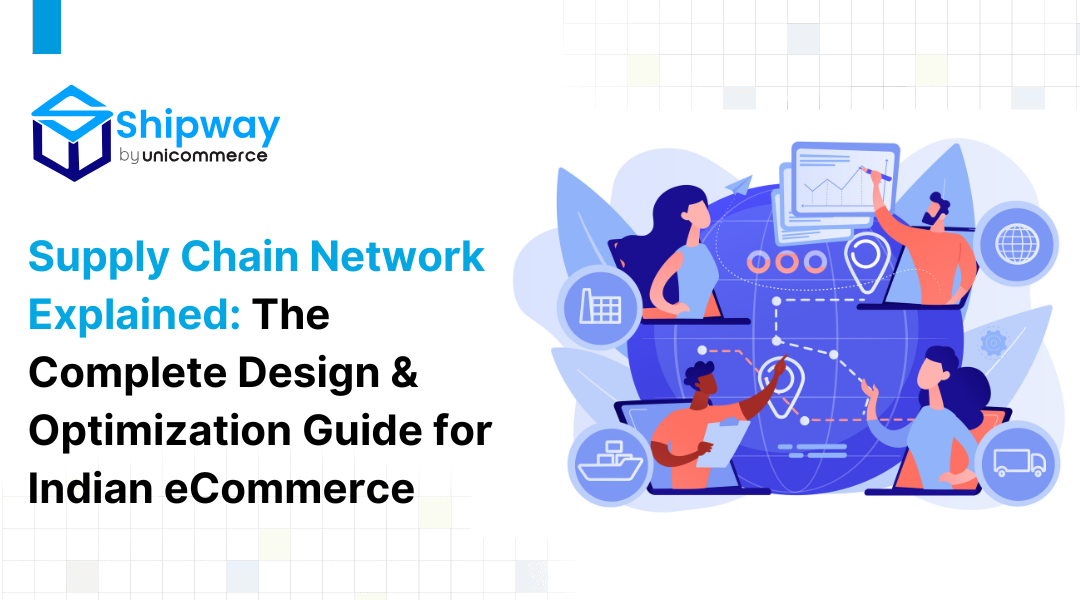
A supply chain network is the full connected system of suppliers, warehouses, courier partners, and return hubs that moves products from manufacture to a customer’s doorstep, and back if needed.
For an Indian D2C brand, this could look like: a manufacturer in Surat ships to a warehouse in Delhi, which fulfills orders across 200 cities using three couriers allocated by pin code, cost, and delivery speed. Every node and every handoff in that system is your supply chain network.
The key word is network not pipeline, not chain. Multiple paths. Multiple decision points. All working together, or against each other, every single day.
Supply chain network design is the discipline of making those decisions intentionally: where warehouses sit, how inventory is distributed, which couriers handle which zones, and how data flows between all of it.
Most brands don’t do this. They start with defaults and add exceptions. That’s how you end up with one warehouse, two couriers, and a spreadsheet holding it all together.
How Do You Optimize a Supply Chain Network? A 5-Step Framework
Supply chain network optimization isn’t a one-time project. It’s an ongoing cycle. Here’s the framework that works for Indian eCommerce brands at scale.
Step 1: Map demand before you move anything
Pull your last 6–12 months of order data. Map it by state, city, and pin code cluster. You will almost always find that 60–70% of your orders come from 10–15 cities.
That concentration is your network design anchor. If 40% of your orders ship to Delhi-NCR, Bengaluru, and Mumbai and your only warehouse is in Pune, you already know where the problem is.
Step 2: Place warehouses against your demand map, not your HQ
The goal of supply chain network design is simple: minimize the average distance between your stock and your customers.
For most Indian brands, two fulfillment nodes one in the North or West, one in the South or East dramatically improve delivery speed across the country. Metro-focused brands serving Mumbai, Delhi, Bengaluru, and Hyderabad can reach 40–50% of India’s online shoppers from two well-placed centers.
Not ready to own warehouse space? Third-party logistics (3PL) providers let you add regional nodes without the capital commitment. The network benefit is the same.
Step 3: Allocate inventory by velocity, not equality
Don’t split inventory 50-50 across two warehouses and call it distribution. Use sales velocity data. Stock more units of your top-performing SKUs at every regional location. Keep slower-moving inventory at your central hub.
This reduces split shipments, cuts delivery time, and prevents the worst scenario: a customer ordering something that’s in stock nationally but out of stock at the fulfillment point closest to them.
Step 4: Automate courier allocation
Manual courier selection is slow, inconsistent, and almost always suboptimal. An automated courier allocation engine evaluates every order in real time, considering pin code serviceability, courier performance history at that location, cost, weight, delivery speed SLA, and assigns the best option in seconds.
This single change can reduce per-order shipping cost by 12–18% and improve delivery success rates meaningfully. It also removes the operational load of managing multiple courier relationships manually.
Step 5: Track the metrics that actually tell you if it’s working
A supply chain network is never finished. Track these consistently:
- RTO rate by courier and pin code cluster
- Average shipping cost per order
- On-time delivery rate by zone
- Delivery TAT (turnaround time) by region
- Return processing time
Use this data to renegotiate courier contracts, adjust inventory placement, and identify zones where your current design is underperforming.
What Are the Biggest Challenges in Supply Chain Network Management?
Even well-designed networks face these. Knowing them in advance lets you build solutions in from the start.
1. Stockouts
When a high-demand SKU runs out at the nearest fulfillment point, you either ship from a distant warehouse (higher cost, longer TAT) or lose the sale. Poor demand forecasting and slow replenishment cycles are almost always the cause.
2. High RTO in COD markets
COD-heavy Tier 2 and Tier 3 orders carry structurally higher RTO risk. The brands managing this best aren’t reducing COD coverage they’re using NDR (Non-Delivery Report) management to proactively follow up with customers when a first delivery attempt fails. That follow-up, within the same day, is what converts a near-miss into a delivered order.
3. Shipping cost creep
Costs rise when brands default to a single courier for all orders, skip rate negotiations, or route shipments through inefficient paths. A multi-courier strategy with automated allocation is the most reliable structural fix.
How Shipway Plugs Into Your Supply Chain Network
For Indian D2C brands processing hundreds of orders daily, the gap between knowing the framework and executing it at scale is real. Shipway is built specifically to close that gap.
Shipsense AI
The AI-powered courier allocation engine automatically assigns the most suitable courier for every order based on pin code, warehouse location, courier performance history, cost, and delivery SLA. No manual rules. No blanket assignments. Shipway is integrated with 10+ courier partners, including Delhivery, Bluedart, DTDC, Xpressbees, and Ekart, covering 29,000+ pin codes.
NDR Management
When a delivery attempt fails, Shipway’s dashboard consolidates all the RTOs in one dashboard and triggers automated follow-ups via WhatsApp. Brands using Shipway have reduced RTO by up to 67%. At 1,000 daily orders, that’s the difference between 300 returns and 99.
Return Management Automation
Shipway’s self-service returns portal handles exchange and refund requests end-to-end, reducing manual ops load while keeping the post-purchase experience clean enough that customers come back.
Analytics and Reporting
Shipway brings courier-level performance data, RTO trends by pin code, NDR root cause analysis, and delivery timelines into a single dashboard. This is the visibility layer that makes supply chain network optimization a continuous process rather than a quarterly guess.
Brands like Lenskart, Zouk, Astrotalk, and Phool run their post-purchase supply chain operations on Shipway across 29,000+ pin codes, 50 million+ shipments.
Conclusion
Pull your RTO data by pin code. Pull your shipping cost by courier. The breaks in your supply chain network are already in your data waiting to be read.
That’s your optimization roadmap. Everything else is execution.
What is supply chain network design?
How does supply chain network optimization reduce RTO?
How many courier partners should I work with?
How do I start optimizing my supply chain network?