

Two parcels with the same scale weight can bill very differently because couriers charge on chargeable weight, which is the higher of actual and volumetric weight. They then apply the delivery zone, weight slab, courier rate card and add ons such as COD fees and fuel surcharge.
Pull up any Monday invoice and you will probably spot it. Two orders, both logged as 1 kg in your system. One came in at a price nobody blinked at, and the other cost nearly double. Finance wants to know why, and ops points at the courier. In most cases the courier is just following its rate card, and the small gaps pile up quickly. Shipway’s volumetric weight calculator shows that a 500 g pillow in a 40 × 40 × 40 cm box can bill at 12.8 kg. Shipway’s weight discrepancy analysis finds that even a 300 to 500 gram gap costs sellers ₹18 to ₹35 per order. So let us unpack where the difference comes from, and how you can work out estimated courier charges before you book.
Why do two parcels of the same weight cost different amounts to ship?
Your parcel’s weight is only one part of the shipping cost. The final courier charge also depends on several other factors:
- Chargeable weight: Whether the courier charges by actual weight or volumetric weight.
- Delivery zone: Where the parcel needs to go.
- Weight slab: Whether the parcel falls into a higher weight bracket.
- Courier partner: The rates and service you choose.
- Payment method: Whether the order is prepaid or COD.
- Additional charges: Fuel surcharges, remote area fees and RTO charges, where applicable.
- Weight corrections: Any difference between the weight declared at booking and the weight recorded by the courier.
Whether you’re checking rates from a large courier company or a regional delivery partner, these factors can affect how much you pay for shipping.
What is chargeable weight and why is it higher than actual weight?
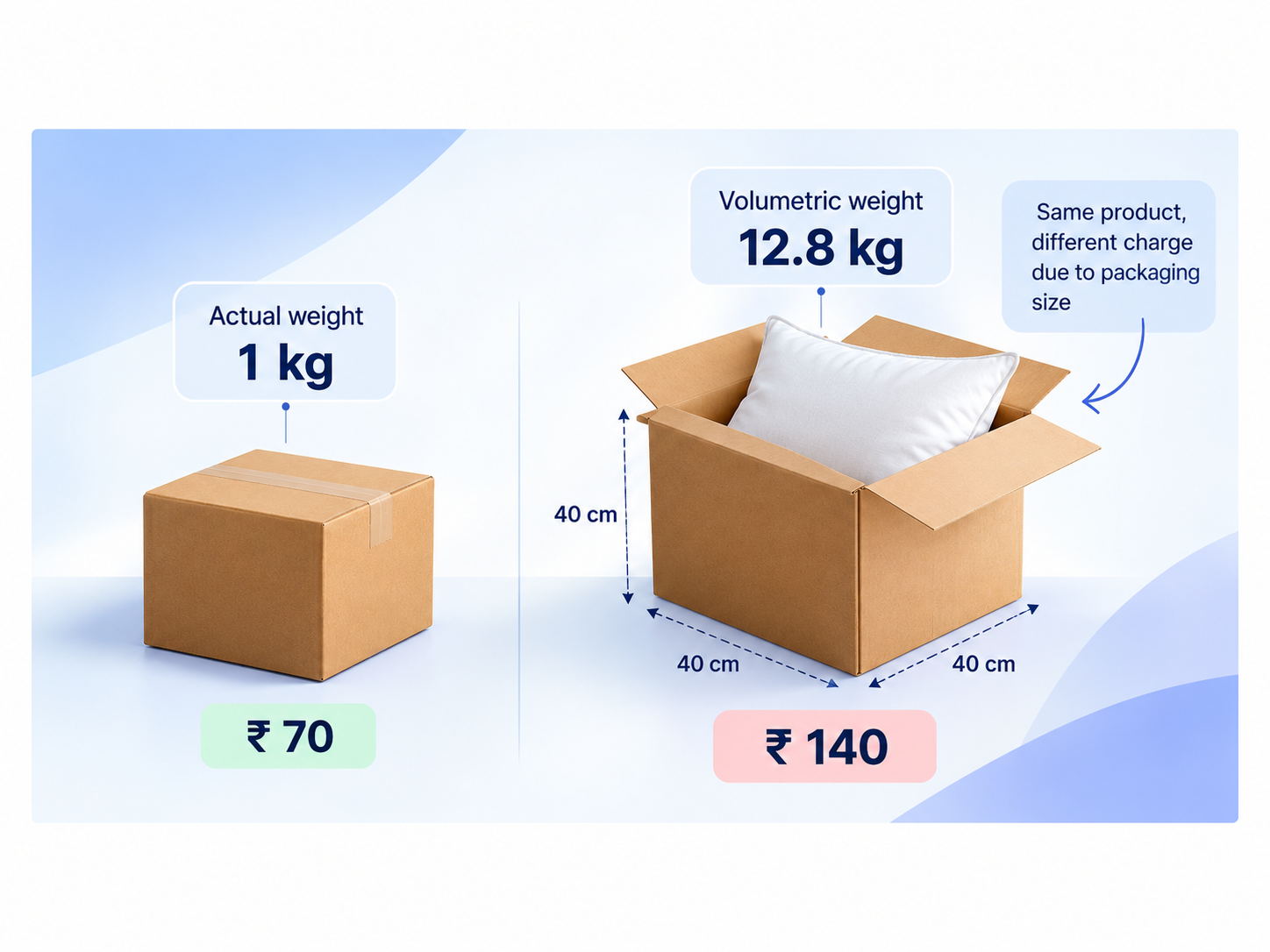
Courier companies consider both a parcel’s weight and the space it takes up during transit. That’s why they compare its actual weight with its volumetric weight and charge based on whichever is higher.
Here’s a more natural and reader-friendly version:
Volumetric weight is calculated using the parcel’s length, width, and height. Many courier companies in India use this formula:
Volumetric weight = (Length × Width × Height) ÷ 5000
For example, a box measuring 30 × 20 × 15 cm has a volumetric weight of 1.8 kg, even if its actual weight is lower.
The calculation can vary by courier. Some use a divisor of 4000 or 6000, which means the same parcel can have different chargeable weights with different courier partners.
Consider a pillow weighing just 500 g packed in a 40 × 40 × 40 cm box. Its volumetric weight could be 12.8 kg with a divisor of 5000. You could end up paying for much more than the pillow’s actual weight simply because the box takes up more space.
This is where SKU-level visibility pays off. If your catalog stores only dead weight, your system cannot see which SKUs get billed on volume. Store packed dimensions and packaging type against every SKU.
How does the delivery zone affect courier charges per kg?
Every courier divides India into zones, typically local, within state, metro to metro, rest of India and remote locations. A 1 kg parcel from a Delhi warehouse to Gurugram and the same parcel to Guwahati carry different base rates. That is why courier charges per kg climb with distance and network effort. The NCAER logistics cost study puts road freight at ₹3.78 per tonne km against ₹72 for air, which is why express lanes price so differently.
Your destination mix also moves your blended courier cost per kg even when average weight stays flat. A festive campaign that skews orders towards the Northeast raises cost per order without a single parcel getting heavier.
This also means your shipping costs can go up even when your parcel weight stays the same. If more orders go to distant locations during a festive sale, you may end up paying more per order. Some remote pin codes may also attract additional charges.
Why can two similar parcels have different shipping costs?
Courier companies usually charge based on weight slabs, often in steps of 500 g. For example, a parcel weighing 980 g may fall under the 1 kg slab, while one weighing 1.02 kg may be charged at the 1.5 kg rate.
Even though the two parcels weigh almost the same, the extra few grams can push one into a higher slab, increasing its shipping cost.
Packaging can make a difference as well. A product weighing 950 g might cross the 1 kg mark after adding bubble wrap, tape, and an invoice pouch.
The key is to check the parcel’s weight after packing, not just the product’s weight. Even a small difference can push it into the next slab and increase your shipping cost.
Does the courier partner affect shipping charges?
Yes. Different courier companies have different rates, weight slabs, and rules for calculating shipping charges. A courier that costs less for a 500 g parcel going to a metro city may charge more for a 3 kg parcel going to the Northeast.
That’s why it’s worth comparing courier rates based on the parcel’s weight and destination instead of choosing the partner with the lowest starting price.
Shipway brings 20+ courier partners together on one dashboard. Its ShipSense AI helps select a suitable courier for each order based on factors such as shipping cost, delivery speed, and reliability.
How do COD and other add-ons raise estimated courier charges?
A prepaid parcel and a COD parcel of identical weight going to the same PIN code will not invoice equally. Typical add-ons include a COD handling fee, a periodically revised fuel surcharge, remote area fees, GST, and return freight when delivery fails.
That last one is the quiet cost. Shipway notes that more than 30% of COD orders land in the RTO category. A failed COD order means forward freight plus return freight on one sale. It is also why estimated courier charges taken straight from a rate card are usually lower than what you finally pay.
What is weight discrepancy and why can your bill change after pickup?
Weight discrepancy occurs when the weight entered at booking differs from what the courier measures at its hub. For example, you may book a parcel as 1 kg, but the courier records it as 1.5 kg.
If there’s a difference, the courier may add extra charges to your bill, sometimes days after pickup. Checking the packed weight before dispatch can help avoid unexpected costs.
Shipway’s analysis of weight-discrepancy disputes finds that, for flagged shipments with a 300 to 500-gram gap, sellers routinely lose between ₹18 and ₹35 per order. At 2,000 orders a month, that is not a rounding error. Shipway’s Weight Management Suite uses AI to suggest packing choices, predict discrepancy risk, and recommend weight freezes.
How can you estimate courier charges before you ship?
Getting this right matters beyond your margin. Baymard Institute finds that about 40% of shoppers who abandon a cart cite extra costs such as shipping, taxes and fees. Use this five step check on every new SKU or carton:
- Measure the packed parcel, not the product.
- Work out volumetric weight and take the higher number.
- Map origin and destination pin codes to a zone.
- Read the slab rate for that zone from the rate card.
- Add the COD fee, fuel surcharge, remote area fee, and GST.
Here’s how two orders containing the same product can have very different shipping costs:
- Order A: The product weighs 0.9 kg and is packed in a 20 × 15 × 10 cm box. Its volumetric weight is 0.6 kg, so the courier charges for 1 kg. The parcel is prepaid and going from one metro city to another.
- Order B: The same 0.9 kg product is packed in a larger 40 × 30 × 20 cm box. Its volumetric weight is 4.8 kg, so the courier charges for 5 kg. The parcel is sent to another part of India with COD.
Same product weight. Five times the billed slab before the zone premium and COD fee even begin.
What can ops and finance teams do to control courier charges?
- Record the correct product and package weight: Maintain a list of each SKU’s weight and packed dimensions to avoid incorrect charges.
- Use standard box sizes: Keep a few box sizes for different products to avoid oversized packaging and unnecessary shipping costs.
- Check weight before dispatch: Weigh packed parcels regularly to catch errors before they lead to extra charges.
- Review courier invoices carefully: Check the billed weight, delivery zone, and weight slab against the details recorded at booking.
- Choose couriers based on the destination: Compare rates and delivery performance for different pin codes, especially those with frequent RTOs.
- Check bulk shipment charges. For B2B shipments, verify carton counts and chargeable weight before approving the final bill.
Shipway brings 20+ courier partners and 19,000+ pin codes into one dashboard, with shipping from ₹19 per 500 gm, as listed on the Shipway homepage. Pair it with the free volumetric weight calculator, and you can see the chargeable weight before the courier does.
Conclusion
Courier charges depend on more than just how much a parcel weighs. Its size, destination, courier partner, and additional fees all affect the final bill. Even small differences in packed weight or dimensions can increase shipping costs over time.
To keep these costs under control, measure parcels after packing, use suitable box sizes, and review courier invoices regularly. These simple checks can help you avoid extra charges and manage your overall shipping expenses better.
Want to see your chargeable weight before the courier does? Enter your carton size and actual weight in Shipway’s free calculator and get the billable weight in seconds, no sign-up needed.
Why is my courier charge higher than the rate card for the same weight?
The rate card shows the base shipping rate, but your final bill may include other charges. These can include volumetric weight, weight slab rounding, COD fees, fuel surcharges, remote area fees, and GST. If the courier records a higher weight after pickup, your bill may increase further.
How are courier charges per kg calculated in India?
Courier charges depend on the parcel’s actual weight, its size, and the delivery location. Couriers generally use the higher of actual and volumetric weight, apply the relevant weight slab and zone rate, and add applicable fees and GST.
How can I estimate courier charges before booking?
Start by weighing and measuring the packed parcel. Calculate its volumetric weight, check the destination zone, and find the applicable rate in the courier’s rate card. Add any applicable COD fees, surcharges, and GST to estimate the final cost. A shipping rate calculator can make this process easier.
Are professional courier charges calculated differently from other couriers?
The structure is the same: higher of actual or volumetric weight, zone rate, slab, and surcharges. What differs is the divisor, slab size,e and rates, so always check the specific rate card.
Do courier service charges change for COD orders?
Yes. COD orders usually carry a handling fee, and a failed COD delivery can add return freight. Two equal weight parcels to the same pin code can bill differently if one is prepaid and one is COD.