Most ecommerce founders believe their logistics are underperforming because they have the wrong courier partner. So they switch. RTO stays high. Support tickets keep piling up. Deliveries still go silent for three days at a stretch. The courier is rarely the problem. The problem is that your warehouse, your courier, and your customer communication system have never spoken to each other. Every order travels through three separate worlds, and no one is watching what happens in the gaps.
That is the gap that connected logistics is designed to close. And the brands that close it first are not just delivering faster. They are compounding an operational advantage that gets harder to match every quarter.
What Connected Logistics Actually Means
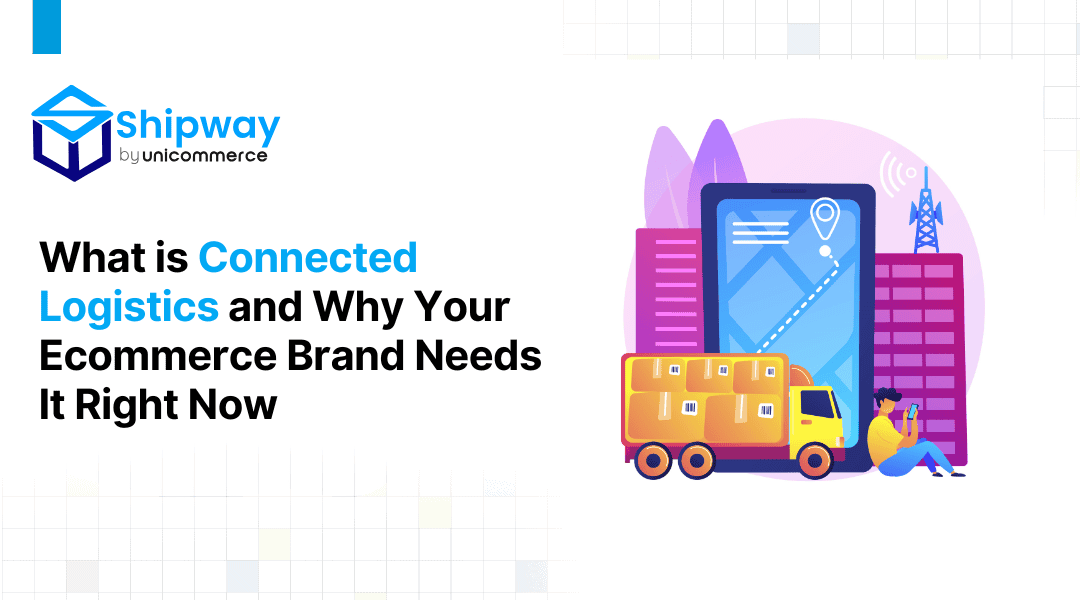
Connected logistics is not a product category. It is an operational state where every part of your supply chain shares data in real time: order management, warehouse systems, courier allocation, customer communication, and returns processing all function as one unified system rather than five separate tools your team switches between manually.
Here is what it looks like in practice. A customer places an order at 11 pm. By 11:01 pm, the warehouse has updated stock. By 11:02 pm, the best available courier has been automatically allocated based on that pin code’s historical delivery performance and current SLA commitments. By morning, a branded tracking link has been sent to the customer on WhatsApp. If the delivery fails, an automated message goes out within the hour asking the customer to confirm a reattempt window. The return, if it happens, is logged and processed without anyone on your team lifting a finger.
None of those steps involves a human making a manual decision. That is the point.
The Real Cost of Disconnected Systems
If your logistics systems are not connected, you are carrying costs you have not yet calculated.
RTO rates for COD orders in Indian ecommerce run between 20 and 40 percent. At a 30 percent RTO rate on 500 daily orders, you are absorbing the forward shipping cost, the reverse pickup fee, and the repackaging cost on 150 orders every single day. On a 500 rupee average order value with a 60 rupee two-way logistics cost, that is 9,000 rupees in dead shipping spend daily, before you count the lost margin on the order itself.
Manual courier selection at that same volume costs two to three ops hours daily. Failed delivery reattempts that nobody follows up on convert to RTOs at a rate of 60 to 70 percent when there is no automated NDR system in place. WISMO queries, meaning customers asking where their order is, account for a large share of support tickets for most D2C brands running without proactive communication. Each ticket costs your team time that could have been redirected to growth.
The status quo is not neutral. It has a price. Most brands just have not added it up yet.
Why Brands Running Manual Logistics Hit a Ceiling at 300 Orders Per Day
At 100 orders a day, manual logistics feels manageable. Your team knows the couriers. Exceptions get handled personally. RTOs are annoying but not alarming. This is the stage where most founders conclude that their operations are fine.
Here is what changes at 300 to 500 orders: every manual process compounds. The courier your team used to handpick becomes the courier they pick by habit, regardless of performance. The spreadsheet that tracked exceptions becomes the spreadsheet that misses them. The support inbox that two people could manage becomes the inbox that needs five. You are not scaling a business at this point. You are scaling a manual process, and manual processes do not scale.
Connected logistics removes the ceiling. When systems are integrated, adding 200 more daily orders does not require two more operations staff. The system handles the allocation, the tracking, the communication, and the NDR follow-up automatically. Your team handles exceptions only.
The Five Components That Make Connected Logistics Work
- Order Management Integration
Orders from Shopify, WooCommerce, Amazon, and every other channel flow into one dashboard automatically. No manual imports, no lag, no missed orders. When this works correctly, your warehouse knows about an order the moment it is placed, regardless of which channel it came from.
- Smart Courier Allocation
Instead of your team deciding which courier to use, the system picks the best option based on real data: pin code serviceability, each courier’s delivery success rate for that area over the last 30 days, current SLA commitments, and cost parameters you set. The right courier gets assigned before your ops team has finished their morning chai.
- Branded Real-Time Tracking
Customers track their order on a page that lives on your domain, not a courier’s generic portal. Every update is pulled automatically from all courier partners into one view. Brands using Shipway’s branded tracking have recorded a median 43 percent reduction in WISMO queries within 60 days of deployment, across brands shipping between 500 and 5,000 orders per month.
- Automated NDR Management
When a delivery attempt fails, the system immediately reaches out to the customer via WhatsApp or SMS to confirm a reattempt window or update their address. Unmanaged failed deliveries convert to RTOs at a high rate. Automated NDR follow-up cuts that conversion rate significantly because the response window is minutes, not days.
- Returns and Reverse Logistics
A connected returns system lets customers initiate returns on your website, tracks the return shipment, and triggers refunds or exchanges automatically. Returns handled this way are not just cheaper to process. They convert. A customer who gets a smooth return experience is significantly more likely to purchase again than one who had to call your support team three times to get a refund.
How Automation Makes This Run Without Constant Human Oversight
Automation is what turns connected logistics from a promise into an operating reality. Without automation, integration is just data sharing. With it, data sharing becomes action.
Smart courier allocation removes the guesswork and the habit-based decisions from shipping. Automated status updates mean customers are informed at every milestone without your team triggering a single message. NDR management turns failed deliveries into reattempt opportunities rather than automatic RTOs. Return automation handles the entire return lifecycle, from customer request to pickup scheduling to refund initiation, without manual intervention at each step.
The longer-term benefit is data. When all your logistics information flows through a single connected system, you can see patterns that are invisible when data lives across five portals. Which couriers have the best delivery rates in which regions? Which PIN codes generate the most RTOs? Which communication channels drive the highest reattempt success? These insights feed back into the system and improve performance continuously.
How Shipway Gives Growing Brands This Infrastructure Without the Complexity
Building connected logistics from scratch requires engineering resources that most D2C brands do not have and cannot justify at the growth stage. Shipway is built to give brands the infrastructure without the build cost.
A brand that connects Shipway gets multi-courier integration across partners, including Delhivery, Bluedart, Ekart, Xpressbees, and DTDC, and more, covering 29,000+ pin codes nationwide, with automated courier allocation based on real performance data. Orders sync from Shopify, WooCommerce, Amazon, and 50-plus other integrations automatically, labels are generated, and pickups are scheduled without anyone in the loop.
Before Shipway, a brand shipping 500 orders a day might spend two to three hours on manual courier selection and shipment updates. After connecting, that same task takes minutes, and the decisions are driven by past courier performance data on each pin code. Branded tracking goes live on their own domain, post-purchase communication goes out automatically via WhatsApp, SMS, and Email, and returns become a self-service experience for the customer rather than a support burden.
For growing D2C brands, Shipway provides enterprise-grade connected logistics without requiring a dedicated engineering team to build or maintain it.
Connected Logistics Is No Longer Optional for Brands That Want to Scale
The brands scaling fastest in Indian ecommerce right now are not winning on product alone. They are winning on what happens after the buy button. Every order that ships late, arrives without a tracking update, or bounces back as RTO is a customer you paid to acquire and handed to a competitor.
Connected logistics is how you stop that from being the default. It takes the chaos of fragmented systems and replaces it with one integrated, automated, data-driven operation where every moving part works together.
The infrastructure to do this exists. The brands that build it this year will not just operate better. They will make it structurally harder for brands that do not compete on delivery experience, return rates, or customer retention.
In ecommerce, growth does not just depend on selling more. It depends on whether the system behind the sale can hold the weight of your ambition.
What is connected logistics in simple terms?
Connected logistics means your inventory, orders, shipping, tracking, customer notifications, and returns all work together in one integrated system rather than as separate, disconnected processes. It eliminates manual handoffs, reduces errors, and creates a smoother experience for both your operations team and your customers.
Why is connected logistics important in ecommerce?
Because customer expectations are no longer benchmarked against other D2C brands. They are benchmarked against Amazon. Brands that cannot deliver fast, communicate proactively, and handle returns smoothly lose repeat purchase rates regardless of how good their product is.
How does connected logistics reduce RTO rates?
Connected logistics reduces RTO by automating NDR management, so when a delivery fails, the system reaches out to the customer within minutes to confirm reattempt details. It also uses smart courier allocation to match each shipment to the courier with the best delivery record for that specific pin code, lowering the probability of failure before the order even ships
What happens when logistics systems are disconnected?
Disconnected logistics creates a chain of invisible costs: delayed dispatches, high RTOs because failed deliveries go unmanaged, inventory mismatches because stock updates do not sync automatically, and support overload because customers have no proactive tracking information.
Is connected logistics only for large ecommerce brands?
Not at all. Mid-sized and growing D2C brands often see the biggest impact because connected logistics removes the operational bottlenecks that slow growth at the 300 to 500 orders per day stage. Platforms like Shipway are built specifically for brands at this scale.