
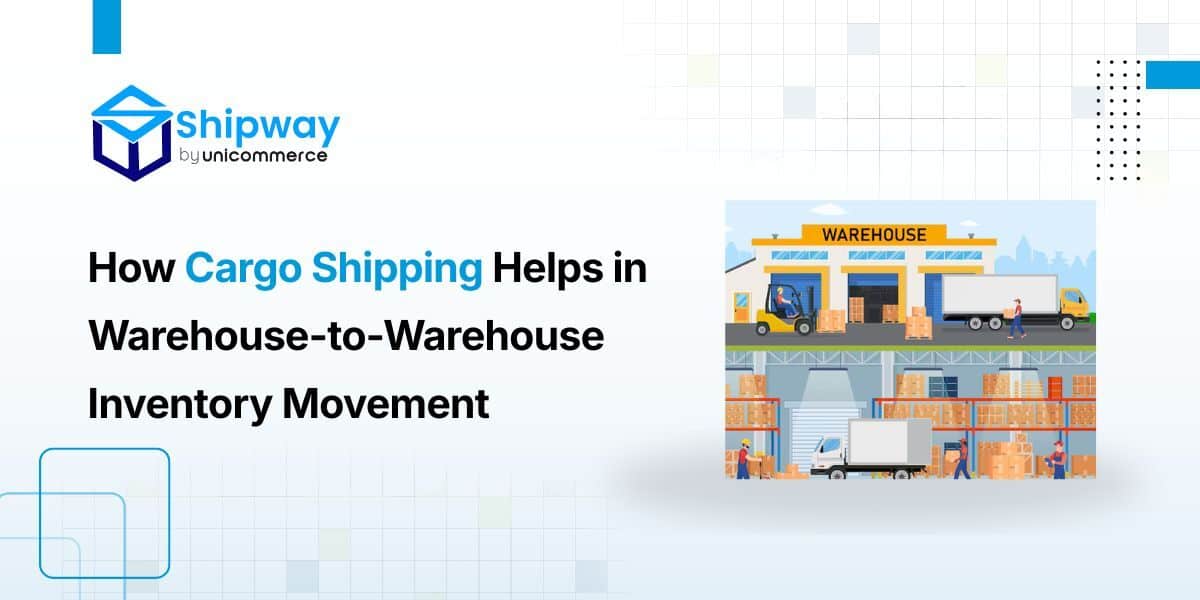
As e-commerce and retail networks scale, inventory movement between warehouses becomes a critical operational function, not just a logistics task. Cargo shipping enables businesses to move bulk inventory efficiently across cities and regions, supporting planned replenishment, hub-to-hub transfers, and large-volume stock balancing without the cost inefficiencies of parcel shipping.
In this blog, we’ll walk you through how heavy parcel delivery simplifies warehouse-to-warehouse inventory movement, where it fits best compared to parcel logistics, and the key operational advantages it offers for growing brands and enterprises.
What are Warehouse-to-Warehouse Inventory Movement?
Warehouse-to-warehouse transfers involve moving stock between facilities to correct inventory gaps, support regional demand, or bring goods together for smoother downstream distribution. For businesses running multiple warehouses or serving varied geographies, these transfers are a core operational requirement, not an exception.
With the support of modern systems like warehouse management software and real-time visibility tools, teams can plan transfers more efficiently, minimize operational disruptions, and keep inventory records accurate. These movements become especially critical during seasonal demand changes, unexpected sales surges, or when supply chains face temporary disruptions.
Why Warehouse Transfer Matters?
Keep stock aligned with demand by moving inventory to locations where orders are coming in faster.
- Maintain accurate inventory positions while avoiding overstocking and underutilized storage space.
- Optimize logistics spend through planned bulk movement and better utilization of transport and warehouse capacity.
- Enable omnichannel fulfillment by ensuring the right stock is available across online and offline selling points.
- Build supply chain resilience by responding quickly to demand shifts, disruptions, or unexpected market changes.
What is Cargo Shipping & How Does It Fit for Warehouse-to-warehouse Transfer?
For warehouse-to-warehouse transfers, it fits perfectly by enabling cost-efficient, planned inventory movement across locations, especially for inter-city, inter-state, and hub-to-hub stock transfers.
Who is this for?
1. Brands with multiple warehouses: Brands operating more than one warehouse often need to move stock between locations to maintain availability and reduce fulfillment delays. Cargo shipping supports planned, high-volume transfers between warehouses, making it easier to reposition inventory without relying on fragmented or ad-hoc transport arrangements, especially when shipments are heavy or time-sensitive.
2. Sellers managing regional fulfillment centers: For sellers supplying multiple regional fulfillment centers, cargo shipping enables efficient replenishment at scale. Instead of breaking inventory into smaller parcel shipments, cargo allows bulk movement of goods from central or regional hubs to fulfillment centers, ensuring stock reaches the right region on time and in the right quantities, particularly during demand spikes or expansion phases.
3. Businesses rebalancing inventory across locations: When inventory builds up in one location while another faces shortages, cargo shipping provides a structured way to rebalance stock across the network. It supports inter-warehouse transfers for fast movers, new launches, or regional demand shifts, helping businesses avoid stockouts, reduce excess holding, and keep sales running smoothly across all locations.
How Shipway Helps in Warehouse-to-Warehouse Transfer?
- Designed for bulk and consolidated shipments: Ideal for moving large quantities of inventory in a single, planned movement instead of multiple fragmented shipments.
- Supports inter-city and inter-state transfers: Enables reliable long-haul movement between warehouses, hubs, and fulfillment centers across regions.
- More efficient than parcel slab stacking: Reduces per-unit shipping costs by avoiding higher parcel slabs that kick in with heavier or oversized consignments.
- Suitable for palletized or large-volume goods: Built to handle pallets, cartons, and bulky SKUs that are difficult to ship safely through parcel networks.
Detailed overview of Shipway Cargo Shipping Capabilities
1. Separate Cargo Dashboard:
Shipway Cargo operates on a dedicated cargo dashboard, clearly separated from parcel shipping workflows.
- Shipway Cargo is accessible via a dedicated cargo dashboard
- Sellers log in using their existing Shipway account and switch to cargo shipments
- Built specifically for cargo and bulk workflows
This allows Shipway to support B2B logistics without disrupting parcel operations
Why this matters:
By separating cargo from parcels, teams handling bulk or inter-warehouse shipments get a focused interface aligned with commercial logistics—while parcel ops continue uninterrupted.
2. Manual Order Creation:
Cargo shipments follow a control-first approach, where accuracy takes priority over automation. This is suitable because cargo shipments are typically low-volume and high-value.
Accuracy and control are more important than speed in the early stages
Why this works for cargo:
Unlike parcel shipping, cargo movements are planned, deliberate, and often linked to warehouse replenishment or B2B deliveries, making manual creation practical and operationally safer.
3. Shipment Assignment & Processing:
Once orders are created, shipment handling is structured and predictable.
- Orders are created by the seller
- Shipments are assigned within the cargo dashboard
- Slot-based deliveries are supported where applicable (especially for commercial and dark-store deliveries)
Why this is important:
Cargo shipments often operate on fixed delivery windows and strict receiving SLAs. Slot-based assignment ensures shipments align with warehouse schedules, dark-store intake slots, and commercial delivery expectations.
Conclusion
As supply chains grow more complex, moving inventory between warehouses can no longer rely on ad-hoc or parcel-based shipping methods. Cargo shipping provides a structured, cost-efficient approach to heavy parcel delivery, enabling businesses to plan bulk transfers, reduce logistics costs, and maintain inventory accuracy across locations.
By using a reliable bulky item delivery service, brands can streamline warehouse-to-warehouse inventory movement—whether it’s rebalancing stock, replenishing regional fulfillment centers, or supporting large-scale expansion. Solutions like Shipway Cargo are purpose-built for these use cases, helping businesses move heavy and oversized inventory with greater control, predictability, and operational efficiency.
What is heavy parcel delivery in warehouse-to-warehouse transfers?
Heavy parcel delivery refers to moving large, oversized, or high-weight inventory between warehouses in a single consolidated shipment. It is commonly used for bulk stock transfers, hub-to-hub movement, and regional replenishment where parcel shipping becomes cost-inefficient.
When should businesses use a bulky item delivery service instead of parcel shipping?
A bulky item delivery service is ideal when shipments involve palletized goods, large cartons, or high-volume SKUs. It works best for planned warehouse transfers, inter-city movements, and inventory rebalancing where speed, cost control, and safe handling are more important than last-mile delivery.
How does heavy parcel delivery reduce logistics costs for warehouse transfers?
Heavy parcel delivery avoids higher parcel slabs that apply to oversized shipments. By consolidating inventory into fewer, planned cargo movements, businesses can reduce per-unit shipping costs and optimize transport capacity across long distances.
Who benefits most from using a bulky item delivery service?
Brands with multiple warehouses, sellers managing regional fulfillment centers, and businesses rebalancing inventory across locations benefit the most. A bulky item delivery service enables predictable, large-scale transfers without operational fragmentation.
Is heavy parcel delivery suitable for inter-state warehouse movement?
Yes. Heavy parcel delivery is particularly effective for inter-city and inter-state warehouse transfers, where long-haul transportation, fixed delivery slots, and bulk handling are required to meet warehouse receiving schedules and SLAs.