

Calculating shipping rates for your eCommerce store starts with understanding how couriers charge for deliveries. First, check your package’s actual and volumetric weight. Couriers generally charge you based on whichever is higher. Next, factor in the delivery zone, weight slab, COD fees, GST, and potential RTO costs.
Aditi runs a D2C kurta brand. One order cost her ₹195 to ship when she expected ₹130. The courier did not overcharge her. She had simply missed three things: volumetric weight, COD charges, and GST.
This guide shows you how to avoid that surprise. You will learn how a shipping rate calculator works, how to do the maths by hand, and how to price shipping for your customers.
What is a shipping rate calculator and how does it work?
A shipping rate calculator estimates courier charges before you book a shipment. You enter the pickup PIN code, delivery PIN code, weight, package size, and payment mode. It shows the courier options and the charges for each one.
Shipway’s dashboard includes a rate calculator along with order tracking, channel integration, and NDR tools. The result is only as good as your inputs, so let us look at each one.
What is the difference between shipping cost and shipping rate?
Basis |
Shipping Cost |
Shipping Rate |
Meaning |
The amount you pay your courier partner to deliver an order. |
The amount you charge your customer for delivery at checkout. |
Who pays? |
Your business pays the courier partner. |
Your customer pays your business. |
Impact on business |
Directly affects your shipping expenses. |
Influences customer purchase decisions and shipping revenue. |
Can it differ? |
Depends on factors such as weight, distance, and courier charges. |
Can vary based on your pricing strategy, flat rates, or free shipping offers. |
Example: If your shipping cost is ₹130 and you charge your customer ₹99 for delivery, your business absorbs the remaining ₹31.
If you offer free shipping on orders above ₹999, your business absorbs the full shipping cost for eligible orders.
How do you calculate shipping charges – step-by-step process
Here is the simple formula:
Shipping cost = slab rate for your zone + COD charge + GST + RTO buffer
We will use one example throughout. A package measures 30 × 20 × 15 cm and weighs 0.6 kg. It ships from Delhi to Bengaluru as a COD order.
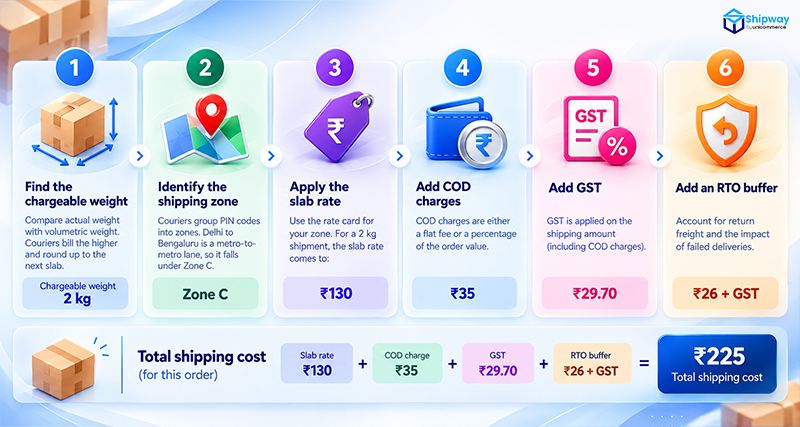
Step 1: Find the chargeable weight
Couriers bill the higher of the actual weight and the volumetric weight. Shipway’s volumetric weight calculator uses L × W × H ÷ 5000, which is standard for most Indian couriers. Some use 4000 or 6000, so always check your courier’s terms.
Let’s say your package measures 30 × 20 × 15 cm. Multiply these dimensions and divide by 5,000, and you get a volumetric weight of 1.8 kg.
Now, the package actually weighs just 0.6 kg. But since couriers charge based on whichever weight is higher, you’ll be billed for 1.8 kg.
And because most couriers round up to the next 500g slab, you’ll end up paying for 2 kg, even though your package weighs only 600 grams.
Step 2: Identify the shipping zone
Couriers group PIN codes into zones, usually from Zone A (same city) to Zone E or F (northeast, J&K and islands). The farther the zone, the higher the rate. Each courier maps zones in its own way, so read our guide to shipping zones in India before you compare rate cards.
Delhi to Bengaluru is a metro-to-metro lane, so we will call it Zone C.
Step 3: Apply the slab rate
A rate card has one price for the first 500g and another for each extra 500g. Our illustrative Zone C rates are ₹40 for the first slab and ₹30 for every extra slab.
A 2 kg shipment has four slabs: ₹40 + (3 × ₹30) = ₹130.
Step 4: Add COD charges
COD charges are either a flat fee or a percentage of the order value. Say it is ₹35 for this order. Your running total is now ₹165.
Step 5: Add GST
At 18 percent, GST on ₹165 is ₹29.70. The shipping cost is now ₹194.70. This is the ₹195 that surprised Aditi.
Step 6: Add an RTO buffer
When a delivery fails, you pay the return freight too. Shipway notes that more than 30% of COD orders land in the RTO category. If 20% of your orders return, add 20% of ₹130, which is ₹26, plus GST to every order’s cost.
Your real cost per order is closer to ₹225. Many sellers overlook this calculation and only realise later that shipping costs are eating into their profit margins.
Which factors change courier rates the most?
When you use a shipping rate calculator, a few factors can change how much you pay for delivery:
- Weight and package size: A large, lightweight package can cost more to ship than a small, heavy one.
- Delivery zone: The farther your package needs to travel, the higher the shipping cost can be.
- Payment mode: COD orders usually come with an additional fee, while prepaid orders don’t.
- Courier partner: Every courier has different rates based on weight and delivery location.
- Delivery mode: Air shipping is generally faster but costs more than surface shipping.
- Additional charges: Fuel surcharges, remote-area fees and other charges may increase your final shipping bill.
How can you cut shipping charges using a shipping rate calculator?
Test your packaging before you print a single label. Aditi switched to a 25 × 18 × 12 cm box. Volumetric weight fell to 1.08 kg, so the slab dropped from 2 kg to 1.5 kg.
The new freight is ₹40 + (2 × ₹30) = ₹100. Add ₹35 COD and 18% GST, and the total is ₹159.30. That saves ₹35.40 per order, or ₹35,400 on 1,000 orders a month.
Run this test for your top five products using a courier charges calculator or your dashboard. It takes ten minutes,s and the savings repeat every month.
Why should you compare couriers instead of checking just one?
Courier rates change by PIN code and zone, so the cheapest courier for Pune may not be the cheapest for Patna. Checking one courier hides the best price.
With Shipway, you can manage 20+ courier partners from one dashboard, with shipping rates starting at just ₹19 per 500g (T&C apply). Plus, ShipSense AI automatically selects a suitable courier for each order, considering shipping cost, delivery speed, and reliability.
Weight disputes are another hidden cost. Shipway’s Weight Management Suite predicts discrepancy risks and suggests weights to freeze. One seller, Awshad, brought weight discrepancies down from 9% to 5% with Shipway, as shown on the shipping cost calculator page.
How should you set the shipping rate your customers see?
Once you know your cost, pick one model:
- Flat rate: simple for customers, works when parcels are similar in size
- Free shipping threshold: raises order value, but build the cost into your pricing
- Shipping rates by PIN code: Charge customers based on their delivery location. This works well if you sell different types of products with varying shipping costs.
- Discounts on prepaid orders: Offer a small discount to encourage COD customers to pay online and help reduce additional COD charges.
Whatever approach you choose, make sure customers know the shipping charges before they reach checkout. Unexpected delivery fees can make shoppers abandon their carts.
Key Takeaways
- Chargeable weight is the higher of actual and volumetric weight
- Add COD charges, GST, and an RTO buffer to get your true cost
- Accurate shipping cost calculation starts with the right weight, zone and payment mode
- Smaller boxes can lower the slab and save money on every order
- Compare couriers by pin code, not by brand
- Set customer shipping rates only after you know your real cost
How do I calculate shipping charges for online orders in India?
Find the chargeable weight, match it to the courier’s slab for your delivery zone, then add COD charges and 18% GST. Use a shipping rate calculator to check all couriers at once.
How do I calculate courier charges per kg?
Divide your chargeable weight by 0.5 to get the number of slabs. Multiply the first slab at its rate, then add the extra slabs at the additional rate. A 2 kg parcel has four slabs.
Is a shipping cost calculator accurate?
It is accurate when you enter the right weight and dimensions. Wrong inputs cause most gaps between the estimate and the final invoice.
Why is my courier bill higher than my shipping rate calculator estimate?
The usual reasons are a weight discrepancy, wrong package dimensions, COD fees, or GST that were left out of the estimate.