Getting the right product to the right customer sounds simple, until you see what happens behind the scenes. If you’re not part of operations, you might be surprised by how many steps a product goes through before it reaches the customer.
Manufacturers manage a complex chain of sourcing, production, storage, and distribution. These stages fall under upstream and downstream supply chain processes. When this flow is handled manually, it can quickly become overwhelming, leading to delays, errors, and rising operational costs.
To that end, in this blog, we explain upstream and downstream supply chain flows, their key components, and practical ways businesses are improving efficiency today.
So, stick with us till the end!
What Does “Upstream” and “Downstream” Mean in the Supply Chain?
1. Upstream Supply Chain:
In simple terms, the upstream supply chain begins with sourcing raw materials and ends when you receive those materials from the supplier for production.
For instance, if you sell cotton shirts, the process starts with finding the best-quality cotton within your budget and the required quantity. Once finalized, the material is delivered to your warehouse, where the shirts are manufactured.
This stage involves several important processes, including:
- Supplier Identification: Finding reliable suppliers who can provide quality raw materials.
- Procurement & Negotiation: Finalizing prices, terms, and quantities with the selected supplier.
- Vendor Management: Maintaining relationships, monitoring supplier performance, and ensuring timely supply.
- Inbound Transportation: Moving raw materials from the supplier to your warehouse or factory.
- Material Receiving & Inspection: Checking quality and quantity before production begins.
- Manufacturing Preparation: Starting the production or assembly process.
2. Downstream Supply Chain
In simple terms, the downstream supply chain begins once the product is ready and continues until it reaches the final customer.
For instance, after your cotton shirts are manufactured, they are stored in the warehouse, processed for orders, shipped, and delivered to customers through retail stores or online channels.
This stage involves several important processes, including:
- Warehousing & Inventory Storage: Storing finished products safely and maintaining accurate stock levels.
- Order Processing & Fulfillment: Picking, packing, and preparing products for shipment.
- Distribution & Transportation: Shipping products to retailers, distribution centers, or directly to customers.
- Last-Mile Delivery: Ensuring the product reaches the customer’s doorstep on time.
- Returns & Reverse Logistics: Handling product returns, exchanges, and replacements efficiently.
Upstream vs Downstream Supply Chain: What’s the Difference?
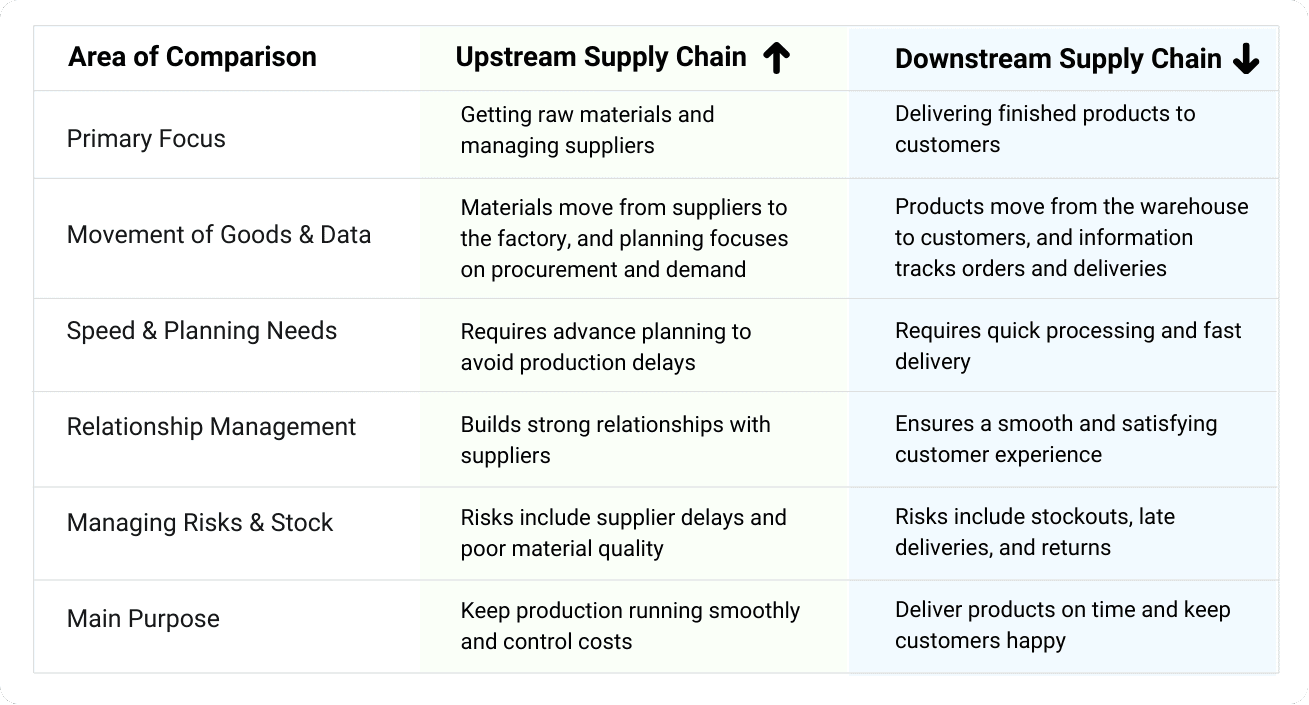
Still feeling unsure about the difference between the two? It’s completely normal. The concepts can seem similar at first. The comparison table below simplifies the key distinctions so you can understand them quickly and clearly.
How Upstream and Downstream Together Keep Business Running Smoothly?
It may sound like upstream and downstream are two separate stages, but they work together to keep customers satisfied. Both require strong coordination and collaboration to ensure products move smoothly from suppliers to the final customer.
And it doesn’t stop there. There are several reasons why businesses must focus on both stages, because ignoring even one can disrupt the entire flow.
Let’s explore why they truly matter:
1. Poor Raw Materials Lead to Poor Final Products
One bad batch can damage the brand trust built over the years. If the quality of raw materials is poor, the finished product will also suffer, leading to complaints, returns, and a loss of customer trust.
2. Supplier Delays Slow Down Production
Even a single delay can create a backlog that takes weeks to recover from. When suppliers fail to deliver on time, manufacturing stops, workers sit idle, and delivery commitments are missed.
3. Poor Planning Creates Stock Problems
Poor coordination between demand planning and procurement can leave you out of stock during peak sales periods or stuck with excess inventory that blocks storage space and working capital.
4. Warehouse Mistakes Lead to Wrong Deliveries
Incorrect picking, incorrect labeling, or picking errors can send the wrong product to customers, increasing returns, re-shipments, and operational costs.
5. Slow Processing Causes Late Delivery
Manual processes and disconnected systems slow down fulfillment. Delayed shipments frustrate customers and push them toward competitors.
6. Poor Handling Leads to Product Damage
Weak packaging or poor transport handling can damage products in transit, resulting in replacements, refunds, and negative customer experiences.
7. Lack of Coordination Creates Operational Confusion
When procurement, warehouse, and delivery teams aren’t aligned, miscommunication leads to missed updates, duplicate efforts, and constant errors.
8. Limited Visibility Leads to Constant Firefighting
Without real-time visibility into inventory, orders, and supplier status, problems are discovered only after they escalate.
How Technology Helps You Stay in Control of Your Supply Chain?
As you can see, even a small gap between upstream and downstream stages can increase costs, delay deliveries, and disrupt operations, often without warning.
Here is the solution many scaling brands are using to manage their supply chain effortlessly: modern technology.
Technology brings everything into one place without burdening teams or increasing costs. So, let’s look into how technology makes this possible:
1. Real-Time Inventory Visibility
Technology lets you track raw materials, production status, inventory levels, and shipments in one place. Instead of calling multiple teams for updates, you can instantly see what’s happening and act faster
2. Better Supplier Coordination
Digital systems help track supplier timelines, deliveries, and performance, reducing follow-ups and preventing production delays.
3. Automated Order Processing
Automation reduces manual errors in picking, packing, and order routing, helping shipments move faster and more accurately.
4. End-to-End Tracking
Track products from supplier pickup to final delivery, improving transparency and helping teams respond quickly to delays.
5. Faster and Accurate Deliveries
Courier integrations and automated shipping decisions ensure faster dispatch and timely deliveries.
6. Data-Driven Decision Making
Reports and analytics provide insights into demand trends, supplier performance, delivery timelines, and operational bottlenecks.
Wrapping Up
The processes of upstream and downstream may sound like operational jargon, but when they run smoothly together, they keep customers satisfied. When raw materials arrive on time, production stays on schedule, inventory remains accurate, and deliveries reach customers without delays, everything works in sync. Even a small gap, however, can lead to unhappy customers.
And here you need a logistics solution that simplifies your operations. With Shipway, businesses can streamline shipping, automate courier selection, enable real-time tracking, reduce delivery delays, and manage returns without operational chaos. Instead of constantly firefighting delivery issues, teams gain clarity, faster dispatch, and a smoother post-purchase experience.
Because at the end of the day, supply chain efficiency is about delivering reliability, building trust, and creating an experience customers want to return to.
What does upstream vs downstream mean?
Upstream and downstream are two stages of the supply chain. Upstream handles sourcing raw materials and suppliers, while downstream deals with delivering finished products to customers.
What is the difference between upstream and downstream in the supply chain?
The key difference is their focus and flow. Upstream in the supply chain handles raw materials, supplier management, and production preparation, while downstream focuses on finished products, order fulfillment, transportation, and delivery to the customer. Upstream prepares the product, and downstream delivers it efficiently to satisfy customers.
What is an example of an upstream supply chain?
A practical example of upstream in the supply chain is a cosmetic brand sourcing ingredients such as oils and extracts, managing suppliers, and preparing them for manufacturing.
What is an example of a downstream supply chain?
A practical example of downstream in the supply chain is a furniture company that stores ready-to-ship tables, processes orders, delivers them to stores or customers, and handles returns or replacements.
What is upstream vs downstream workflow?
The upstream and downstream workflows show the full supply chain flow: upstream covers sourcing, procurement, and production prep, while downstream covers warehousing, shipping, delivery, and returns.