A customer placed two orders last week, yours and a competitor’s. They got the competitors in 6 hours. You delivered after 3 days. Guess which brand they’re going back to.
India’s urban delivery expectation has already shifted beneath most brands. Same-day delivery now commands over 53% of the intra-city logistics market by speed segment. That isn’t a trend cresting, it’s a new floor. And every day a D2C brand, retailer, or B2B distributor runs dispatch on yesterday’s playbook, they’re paying for it in repeat purchase rate, support tickets, and margin.
The Indian intra-city logistics market was valued at USD 33.5 billion in 2025 and is projected to reach USD 43.06 billion by 2031, growing at a CAGR of 4.26%. The brands building fast, reliable local delivery operations today will hold a structural advantage that anyone who waits two years will find extremely expensive to close.
This is what modern intra-city logistics looks like and the playbook that makes it a competitive moat.
What Intra-City Logistics Actually Means (And Why the Definition Matters)
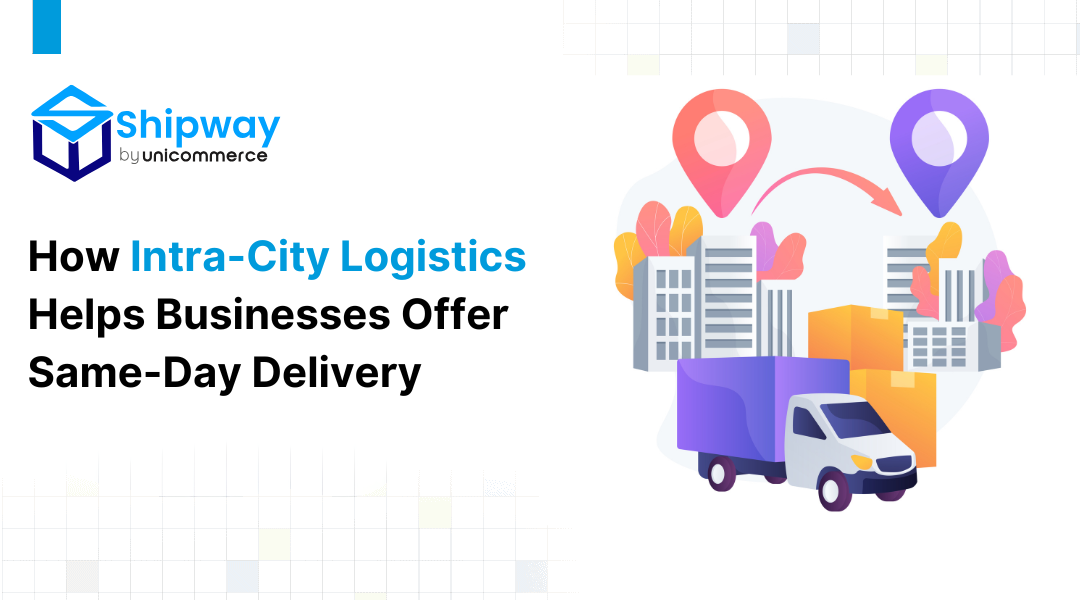
Intra-city logistics refers to the organized movement of goods within the boundaries of a single city or urban area, covering everything from customer order fulfillment to store replenishment, warehouse transfers, and urgent document movement within tight timeframes.
It is not the same as hyperlocal delivery, which covers a 2–5 km radius for near-instant fulfillment. Intra-city logistics can span 20–50 km across an urban area and operate across a broader set of use cases. It is not intercity either, that’s a longer-haul operation with different economics entirely.
The distinction matters because intra-city logistics companies are solving a specific problem: how do you move goods reliably and fast across an entire city, at scale, without the cost spiraling? That’s a route optimization, dispatch automation, and fleet coordination problem, and the brands that treat it as one are the ones pulling ahead.
What Slow Local Delivery Is Costing You Right Now
Before the strategies, name the cost of the status quo because most businesses are underestimating it.
1. Every minute of manual dispatch delay compounds
Automated systems bring order-to-assignment time down from 8–15 minutes to under 60 seconds. At 100 orders a day, that’s hours of recovered delivery capacity every week and measurably fewer late deliveries.
2. Late deliveries without proactive communication generate WISMO (Where Is My Order) queries
Each support ticket costs ₹80–200 to resolve. Brands with no real-time tracking visibility are paying for that silence at scale.
3. Failed first-attempt deliveries are the single biggest cost leak in local delivery
A failed delivery doesn’t just cost the re-attempt; it costs the customer relationship. Research consistently shows that a failed delivery with no communication is one of the top triggers for a customer not reordering.
4. Speed is now a conversion trigger, not a delight feature
In categories like electronics, healthcare, and fashion, a brand that can promise same-day delivery at checkout converts meaningfully higher than one that can’t. If your intra-city logistics operation can’t support that promise, you’re not offering a slower option; you’re offering a reason to go elsewhere.
How to Speed Up Intra-City Delivery: 6 Strategies That Work
1. Get Your Inventory Closer to Your Customers
The fastest way to deliver faster is to not have far to go. Brands investing in dark stores, micro-fulfillment centers, and city-level warehouses are seeing dramatic drops in average delivery time and last-mile cost simultaneously. If your stock is sitting in a single warehouse 35 km from most of your customers, no amount of route optimization will fix your SLAs. Stock placement is a logistics decision first and a delivery speed decision second.
2. Automate Order Assignment
Manual dispatch is slow and error-prone, and it’s a hidden tax on every order you fulfill. Automated dispatch systems assign orders to the nearest available delivery agent based on proximity, vehicle type, and current load. The result: dispatch time collapses from minutes to seconds, idle time for delivery agents drops, and your team focuses on exceptions instead of routine allocation. This single change typically shaves 20–30 minutes off average delivery time without touching anything else.
3. Optimize Order Allocation in Real Time
AI-powered order allocation optimization doesn’t just find the fastest courier. It accounts for delivery performance, RTO percentage, delivery cost, order weight, and other performance-related parameters. Intra-city logistics companies have to optimize the deliveries consistently, report lower RTOs and higher on-time delivery rates at the same time. If your dispatch is still using static rules or manually assigning couriers, you’re leaving both money and speed on the table.
4. Give Customers a Choice of Delivery Speeds
Not every customer needs a 90-minute delivery. Giving buyers a choice between express, same-day, and scheduled options lets them self-select by urgency and willingness to pay. This segmentation improves customer satisfaction and your own unit economics simultaneously because you’re not over-serving low-urgency orders with expensive fast delivery.
5. Make Real-Time Tracking a Brand Experience
Tracking is not a logistics feature. It’s a customer experience touchpoint. Branded tracking pages with live updates via WhatsApp, SMS, and email eliminate WISMO queries before they’re raised, reduce customer anxiety during delivery, and, when executed well, drive repeat purchases by putting your brand in front of the customer at the highest-attention moment of the order journey. Brands running unbranded, non-communicative tracking are paying for it in support volume and repeat purchase rate.
6. Measure What’s Leaking Every Week
The brands improving fastest are the ones measuring relentlessly. Five metrics give you a complete picture of your intra-city delivery health:
- Average delivery time by zone and vehicle type
- On-time delivery rate as a percentage of total deliveries meeting SLA
- Cost per delivery across order types, zones, and partners
- First-attempt delivery success rate: This is your addressability and communication health indicator
- Customer satisfaction score collected post-delivery
If you aren’t tracking these weekly, you are optimizing on instinct. Instinct doesn’t scale.
Which Technologies Improve Intra-City Logistics Operations?
The businesses winning in intra-city logistics right now are not necessarily the ones with the largest fleets. They are the ones with the smartest operations.
AI-powered route optimization reduces delivery time and fuel cost simultaneously by routing agents based on real-time conditions, not static maps. Automated dispatch removes the human bottleneck from order assignment. Live tracking dashboards give operations teams complete visibility across all active deliveries so exceptions are caught before they become escalations.
Delivery analytics surface patterns in delays, failed attempts, and courier performance that manual review would never catch. And API integrations connect your order management system, warehouse tools, and delivery partners into one continuous flow, so nothing falls through the cracks between systems.
Technology is what turns intra-city logistics from a cost center into a precision operation. Without it, you’re managing logistics. With it, you’re optimizing it.
How to Choose the Right Intra-City Logistics Partner
Not all local delivery providers are equal. Before committing, ask these six questions and don’t accept vague answers.
What is their delivery speed and geographic coverage? Make sure they can reach your key delivery zones within your actual SLA requirements, not theoretical best-case times.
Do they provide real-time tracking? Live visibility is non-negotiable for your operations team and your customers.
Is their pricing transparent? Hidden charges around fuel surcharges, weight slabs, and failed delivery attempts compound quickly and destroy unit economics. Get the full tariff in writing.
Can they integrate with your existing systems? A logistics partner without API or platform integration capability creates manual work, not operational leverage.
What does their customer support look like? When deliveries go wrong, and they will, response time and accountability are what determine whether you recover the customer or lose them.
How Shipway Helps Businesses Build Faster, Smarter Local Delivery Operations
Shipway is one of India’s most preferred logistics and post-purchase experience platforms for D2C brands, built to simplify and scale the entire delivery operation from dispatch to confirmation.
Multi-Partner Delivery Management: Shipway aggregates multiple courier and local delivery partners into one platform, giving you flexibility to use the right partner for each zone without managing separate dashboards or relationships. This is what intra-city logistics companies need to stay agile without multiplying operational complexity.
Real-Time Tracking with Branded Notifications: Customers receive live delivery updates via WhatsApp, SMS, and email. Brands can host tracking on their own domain with a custom-branded page, turning a logistics touchpoint into a retention moment.
Automated Shipping Workflows: From order sync to label generation and AI-based carrier allocation, Shipway automates routine tasks, so your team handles exceptions, not the work that should never require human input.
Performance Analytics: Shipway’s analytics dashboard gives visibility into courier performance, delivery timelines, RTO rates, and customer feedback in one place. This is what data-driven intra-city logistics looks like operationally.
Seamless eCommerce Integrations: Shopify, WooCommerce, Magento, and 30+ other platforms order data flows into your delivery workflow automatically.
Build the Operational Edge Before It Becomes the Entry Ticket
The window to make fast local delivery a moat rather than a catch-up project is not permanently open.
When same-day becomes the baseline in your category, and every competitor has access to the same intra-city logistics companies, the advantage moves to execution: how fast you dispatch, how accurately you assign a courier, how clearly you communicate between order and doorstep. The brands that build that operational discipline now will make it structurally expensive for anyone who waits to replicate.
India’s intra-city logistics market is on its way to USD 43 billion by 2031. The infrastructure is being built regardless of whether your brand is using it.
The only question is whether your operation is ahead of that shift, or chasing it.
Key Takeaways
- India’s intra-city logistics market is worth USD 33.5 billion in 2025, growing at 4.26% CAGR through 2031
- Same-day delivery commands 53%+ of the market by speed segment; it’s not a premium anymore, it’s a baseline
- Manual dispatch, lack of real-time tracking, and single-partner dependency are the three most common cost leaks in local delivery operations
- Dark stores, automated dispatch, and assignment optimization are the three highest-leverage infrastructure investments for faster urban fulfillment.
- The right technology partner turns intra-city logistics from a cost center into a measurable competitive advantage
- Shipway gives D2C brands and retailers the tools to manage multi-partner local delivery, automate workflows, and deliver branded post-purchase experiences at scale
What is intra-city logistics, and how is it different from last-mile delivery?
Intra-city logistics refers to the complete movement of goods within a single city, including order processing, courier assignment, pickup, tracking, and delivery confirmation. Last-mile delivery is specifically the final leg: from the nearest hub or dark store to the customer’s door. Intra-city logistics is the broader system; the last-mile is one component of it.
How can a business reduce intra-city delivery costs?
Courier allocation optimization to reduce RTOs, multi-drop delivery batching for nearby addresses, automated order processing to eliminate manual delays, and a multi-partner platform that gives you competitive carrier rates without locking you into one provider. These four levers, applied together, produce the most durable cost reduction.
What should I look for when choosing an intra-city logistics company?
Real-time tracking capability, transparent pricing, multi-courier integrations, strong geographic coverage in your target zones, API integration with your eCommerce platforms, and a demonstrable track record of SLA adherence. Add performance analytics to that list. The right partner helps you improve continuously, not just deliver consistently.