A customer places an order at 3 PM and expects it before dinner. No standard courier will promise that. A two wheeler courier service already does it, every day, across every major Indian city.
This is not a niche delivery option anymore. For any business that sells locally, whether you run a D2C brand, a pharmacy, or a retail store, same-day delivery via bike is now the baseline customer expectation. Blinkit and Zomato set that bar. Your customers are measuring everyone else against it.
This guide breaks down exactly how two wheeler courier services work, why they outperform standard logistics for urban fulfillment, and how to manage multiple bike delivery partners without operational chaos.
What Is a Two Wheeler Courier Service?
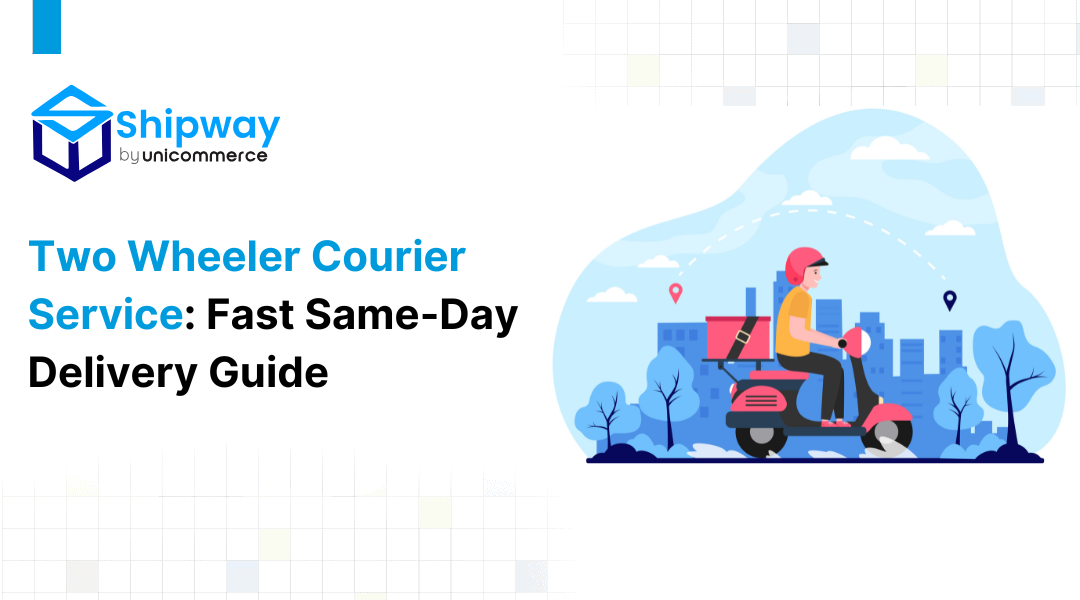
A two wheeler courier service uses bikes and scooters to deliver lightweight packages within a city or specific locality. It is built entirely around one priority: speed within a small geography.
Standard couriers optimize for volume and distance. Two wheeler couriers optimize for fast, last-mile delivery in dense urban environments where traffic kills four-wheeler efficiency. Think of bike delivery as the sprinter of logistics, not the long-distance runner.
Common items delivered via two wheeler courier: Medicines and pharmacy supplies, small eCommerce orders (apparel, accessories, electronics), food and groceries, legal documents and contracts, retail parcels and samples.
Why Bike Delivery Outperforms Four-Wheelers for Urban Orders
Speed is the obvious answer. But the business case runs deeper.
1. Traffic navigation
In dense metros like Mumbai, Delhi, or Bengaluru, a bike can complete a delivery in half the time a car would take on the same route. There is no parking delay, no congestion cost.
2. Lower cost per order
Two-wheelers consume less fuel and carry zero parking overhead. For businesses running high volumes of small local orders, this directly improves per-order margins. Short-distance two-wheeler delivery is consistently more cost-efficient than four-wheeler or long-haul shipping.
3. Reach every corner
Narrow lanes, congested markets, residential colonies. Four-wheelers cannot access these areas efficiently. Bikes can. This matters enormously for pharmacies, local retailers, and food businesses.
4. On-demand flexibility
No scheduling days in advance. Most two wheeler courier platforms operate on-demand. You book when you need it, a rider shows up.
5. Customer experience as a differentiator
When a customer receives their order in two hours with a live tracking link, that is a brand experience. Fast, reliable delivery builds repeat purchase behaviour.
Which Industries Depend on Two Wheeler Courier Services Most?
Almost every local or D2C business benefits. But certain industries treat bike delivery as a non-negotiable backbone.
1. Ecommerce and D2C brands
Same-day delivery is a direct competitive differentiator against marketplace giants. A two-wheeler courier makes it feasible without requiring a large logistics infrastructure.
2. Pharmacies and healthcare
Medicine delivery cannot wait. Whether it is a chronic prescription refill or an urgent over-the-counter need, bike delivery gets it there fast. Pharmacy chains and standalone medical shops both rely on this.
3. Retail stores
A local clothing boutique or electronics shop can now offer same-day delivery within the city, competing directly with large marketplaces.
4. Document and parcel services
Legal documents, contracts, and business samples need secure, fast delivery with proof of receipt. Two-wheeler courier services handle this cleanly.
What are the Real Limitations to Plan Around
No logistics model is without trade-offs. Knowing these in advance lets you build smarter operations.
1. Limited load capacity
Most platforms cap two-wheeler deliveries between 5 and 20 kg per trip. Heavier or bulkier items require a three-wheeler or four-wheeler.
2. Weather disruptions
Heavy monsoon rain slows riders and causes delays. Build buffer delivery windows during the June to September period.
3. Peak hour rider availability
Demand spikes during lunch hours, evenings, and festive sales. Rider assignment times can stretch slightly during these windows.
4. Coverage gaps outside metros
Hyperlocal platforms operate reliably in Tier 1 cities. Coverage in Tier 2 and Tier 3 towns is still inconsistent across providers.
How to Choose the Right Two Wheeler Courier Partner
Multiple platforms are operating in this space. The choice comes down to five factors that actually affect your business.
1. Coverage in your delivery zones
Coverage maps differ significantly across platforms, especially outside metros. Verify before committing.
2. Live tracking and digital proof of delivery
Non-negotiable. Your customers expect a tracking link, and you need POD for dispute resolution.
3. Transparent, predictable pricing
Look for upfront fare estimates based on distance and weight. Surprise charges destroy margins.
4. Delivery success rate
A high rate of failed or delayed deliveries is not worth a low per-order price. Ask for this metric directly.
5. Responsive customer support
When a delivery goes wrong, you need a team that resolves it fast. Evaluate support quality before you scale volumes.
How Shipway Helps You Manage Every Two Wheeler Delivery Partner from One Place
Running deliveries across multiple hyperlocal platforms simultaneously means logging into separate dashboards, chasing separate tracking data, and manually resolving every failed delivery. That operational overhead compounds as order volumes grow.
Shipway connects all your courier partners, including hyperlocal two-wheeler services, under one platform.
1. Multi-carrier integration
Shipway aggregates multiple courier partners in one place. Instead of managing Porter, Borzo, and Shadowfax separately, you control all shipments, statuses, and performance data from a single interface.
2. AI-powered courier allocation
Shipway’s ShipSense feature uses AI to assign the best courier for each order based on pin code serviceability, warehouse location, carrier performance history, and cost. Your two-wheeler deliveries are always routed to the most reliable available option without manual decision-making.
3. Real-time tracking and notifications
Every shipment, whether via a two-wheeler courier or a standard carrier, is tracked live. Automated branded notifications go to customers via WhatsApp and SMS at every milestone, reducing WISMO queries and support load.
4. NDR management automation
When a delivery fails, Shipway’s NDR automation kicks in immediately. Rule-based workflows trigger follow-up actions, re-attempts, and address verifications so failed deliveries do not sit unresolved and bleed RTO rates.
5. Returns and refund automation
Shipway automates the reverse logistics flow, handling return requests, refund triggers, and carrier coordination without manual intervention.
For eCommerce brands scaling urban delivery, Shipway converts multiple disconnected courier relationships into a single, measurable, improvable system.
The Delivery Gap Is Widening. Choose Which Side You Are On
A two-wheeler courier service is no longer a logistics upgrade. For any business selling locally in an Indian city, it is the minimum required to stay in the consideration set.
Customers do not compare your delivery speed to what you promised last year. They compare it to what Blinkit delivered in 10 minutes this morning. Every hour your order sits in a sorting facility is an hour your competitor is earning the next purchase.
The brands winning urban delivery right now are not just using bike couriers. They are managing them intelligently, with automated allocation, live tracking, and NDR systems that catch failures before they become returns. Shipway gives you exactly that infrastructure, without the operational complexity of building it yourself.
What is a two wheeler courier service and how is it different from regular courier?
A two wheeler courier service uses bikes or scooters to deliver lightweight packages within a city, typically same-day or within hours. Unlike regular couriers that focus on intercity volume, two wheeler services prioritize speed and urban reach for time-sensitive intra-city shipments.
What items can be sent via two wheeler courier?
Medicines, documents, small eCommerce orders, food, groceries, clothing, and retail parcels are ideal. Most platforms handle packages up to 10 to 20 kg. Heavier or bulkier items need a three-wheeler or four-wheeler.
How does Shipway help manage two wheeler and hyperlocal deliveries?
Shipway integrates with multiple courier partners including hyperlocal two wheeler providers through a single dashboard. It offers AI-powered courier allocation via ShipSense, real-time tracking, branded customer notifications via WhatsApp and SMS, NDR management automation, and returns automation, helping D2C brands run scalable urban delivery operations.